
Panel 2: Women and Violence
The chief architect of much of the violence in the Nibelungenlied is the beautiful Queen Kriemhild, seeking revenge for Siegfried's death. This was a source of difficulty for many nineteenth-century adapters, who sought variously to make an example of her, to make excuses for her, or to rehabilitate her entirely. But even where there was an attempt to explain her actions, the temptation to depict her at her most transgressive - brandishing the decapitated head of her brother - was almost irresistible. And the scale of that transgression also gave illustrators licence to depict Kriemhild's own violent death, with her final victim, Hagen, lying at her feet.
Kriemhild is not the only violent woman in the Nibelungen material. Her sister-in-law, Brünhild, who is a valkyrie in both Norse legend and Wagner's Ring, was possessed of immense physical strength before her marriage, and children's books in particular often include images of her with her spear. In contrast to Kriemhild, there is ultimately no direct victim of Brünhild's violence, but the illustrators commonly show the fear of the male heroes, as they cower behind a shield, emphasising the threat offered by a physically strong woman.
Kriemhild holding Gunther’s severed head
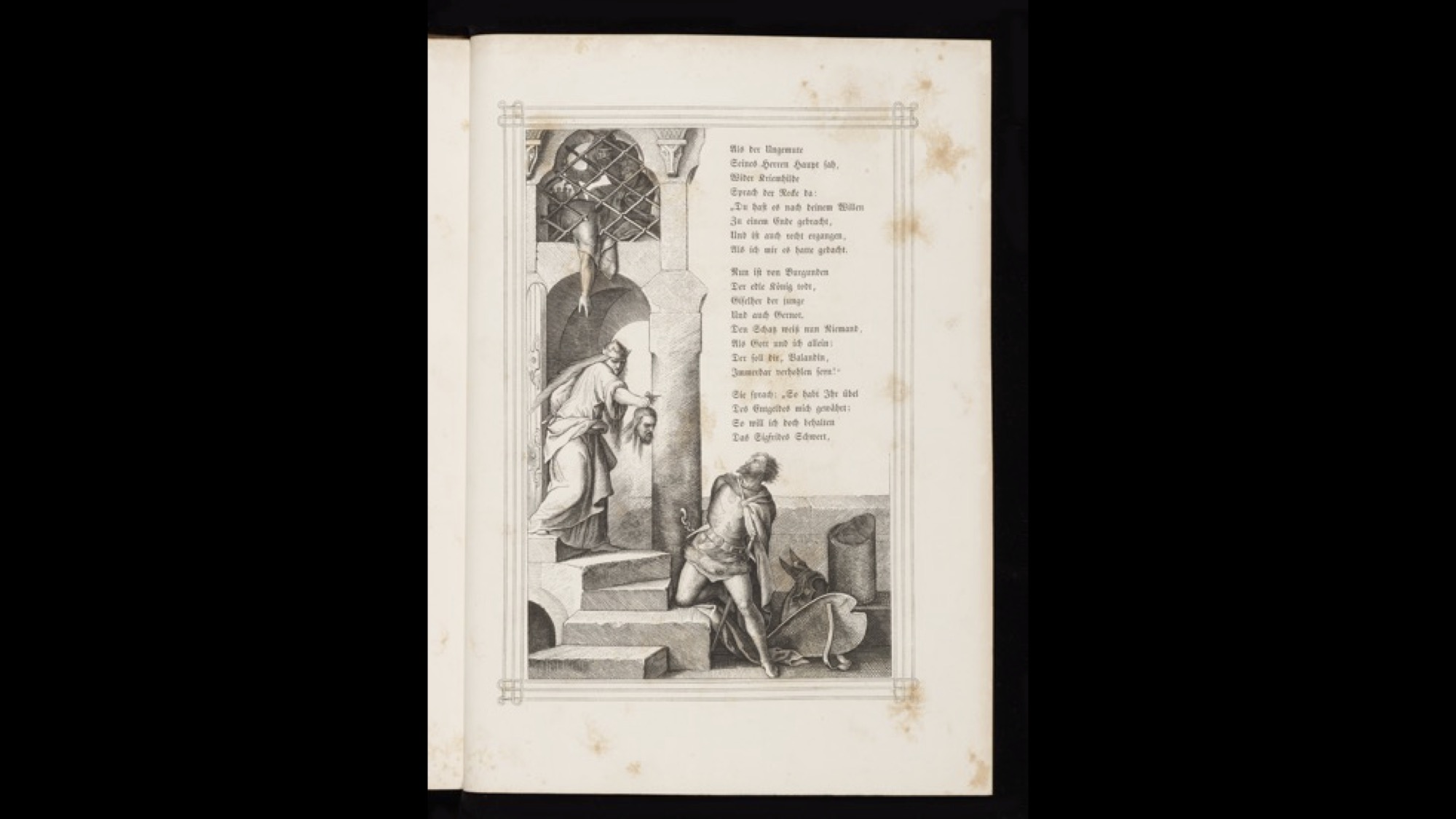
Exhibit 1:
Gustav Pfizer, Der Nibelungen Noth, with woodcuts by the Xylographische Anstalt von Kaspar Braun & [Georg] von Dessauer, based on illustrations by Julius Schnorr von Carolsfeld and Eugen Neureuther, Stuttgart, 1843.
The Bodleian Libraries, University of Oxford: 38.M.13
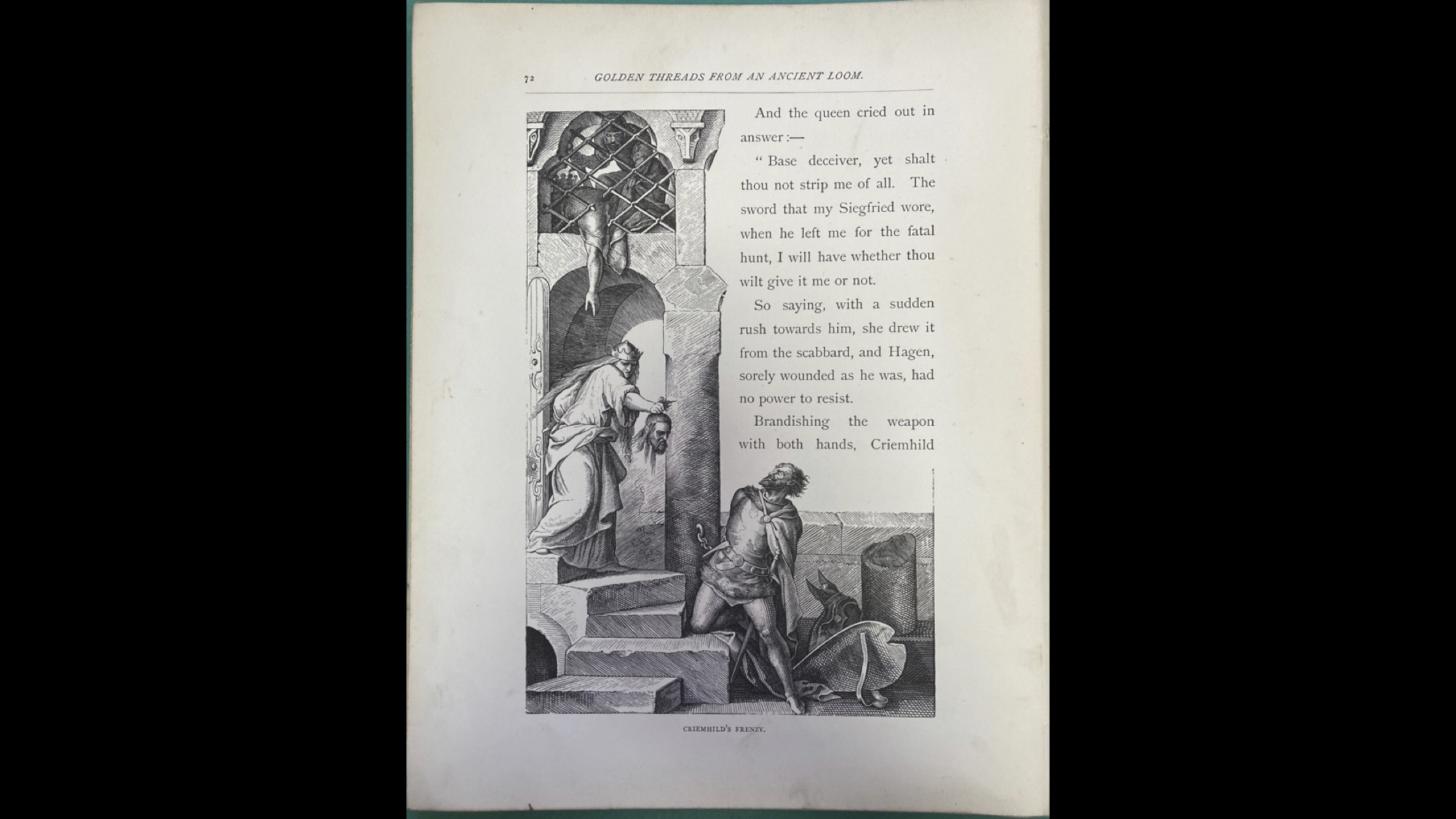
Exhibit 2:
'Criemhild's frenzy'
Lydia Hands, Golden threads from an ancient loom. Das Nibelunglied, adapted to the use of young readers, with fourteen wood engravings by Julius Schnorr, of Carolsfeld, London, 1880. The woodcuts are a selection from Pfizer (1843).
Private loan
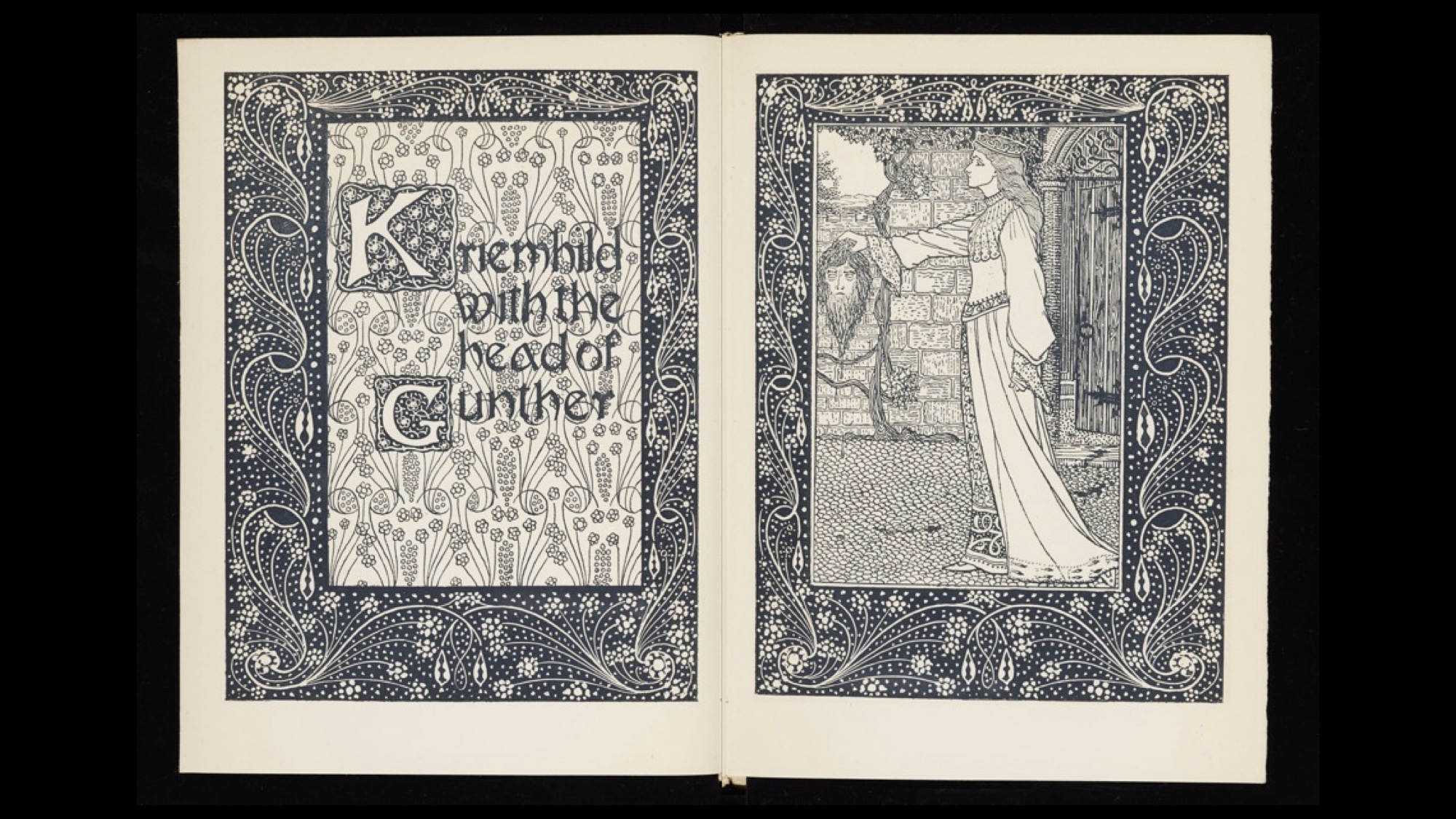
Exhibit 3:
'Kriemhild with the head of Gunther'
Margaret Armour, The Fall of the Nibelungs, illustrated and decorated by W.B. MacDougall, London, 1897.
The Bodleian Libraries, University of Oxford: 28849 e.60
'Then she commanded her brother's life to be taken. His head was cut off, and she carried it by its hair before the hero of Tronje'
Nibelungenlied, stanza 2369
Many adapters were struck by this moment, and chose to depict it, or reprint famous depictions, to demonstrate how outrageous Kriemhild's behaviour was. The event was often placed in a prominent position, at the start of a section, or as a frontispiece.
Kriemhild's death
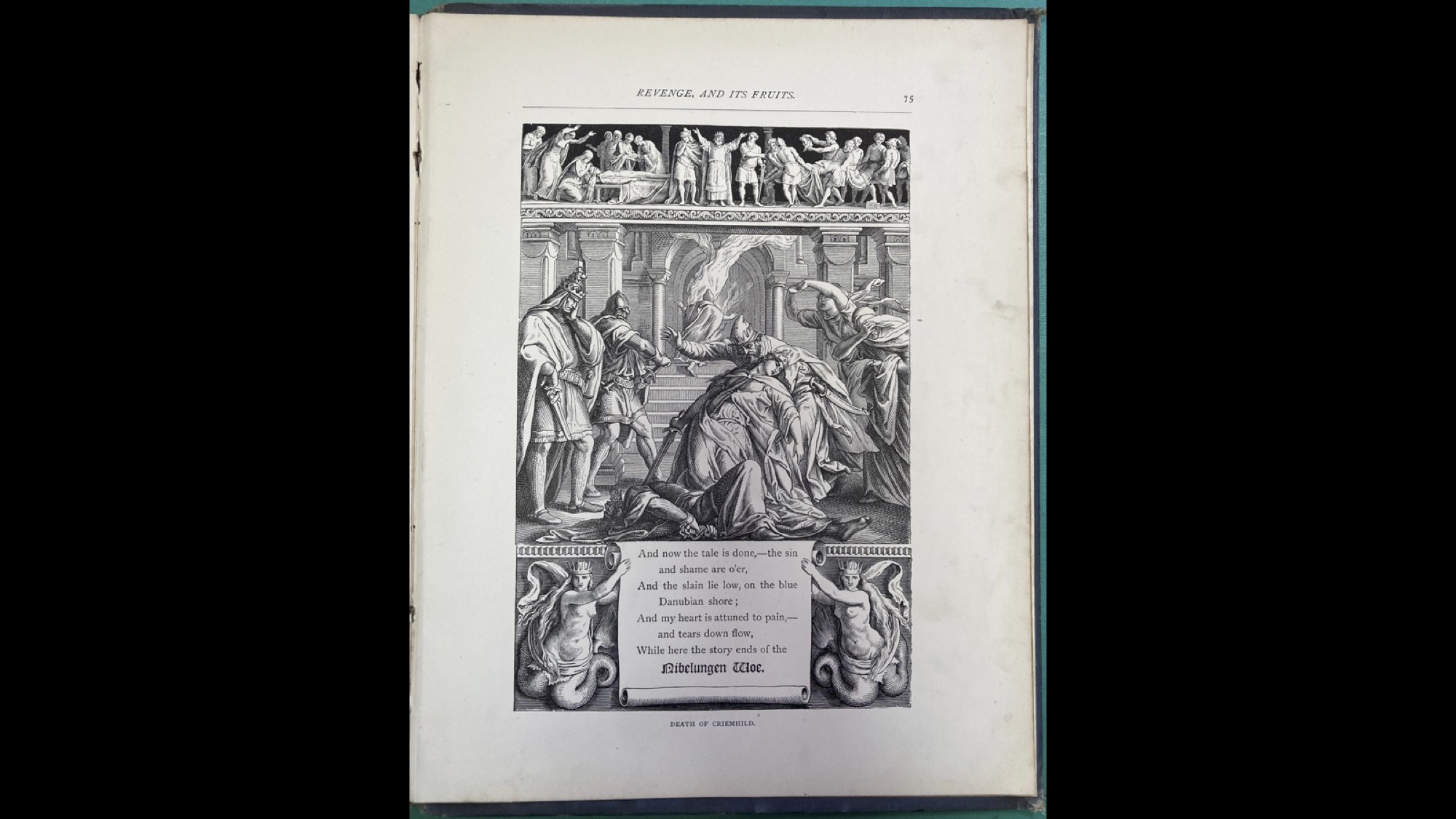
Exhibit 1:
'Death of Criemhild'
Lydia Hands, Golden Threads from an Ancient Loom. Das Nibelunglied, adapted to the use of young readers, with fourteen wood engravings by Julius Schnorr, of Carolsfeld, London, 1880. The woodcuts are a selection from Pfizer (1843).
Private loan
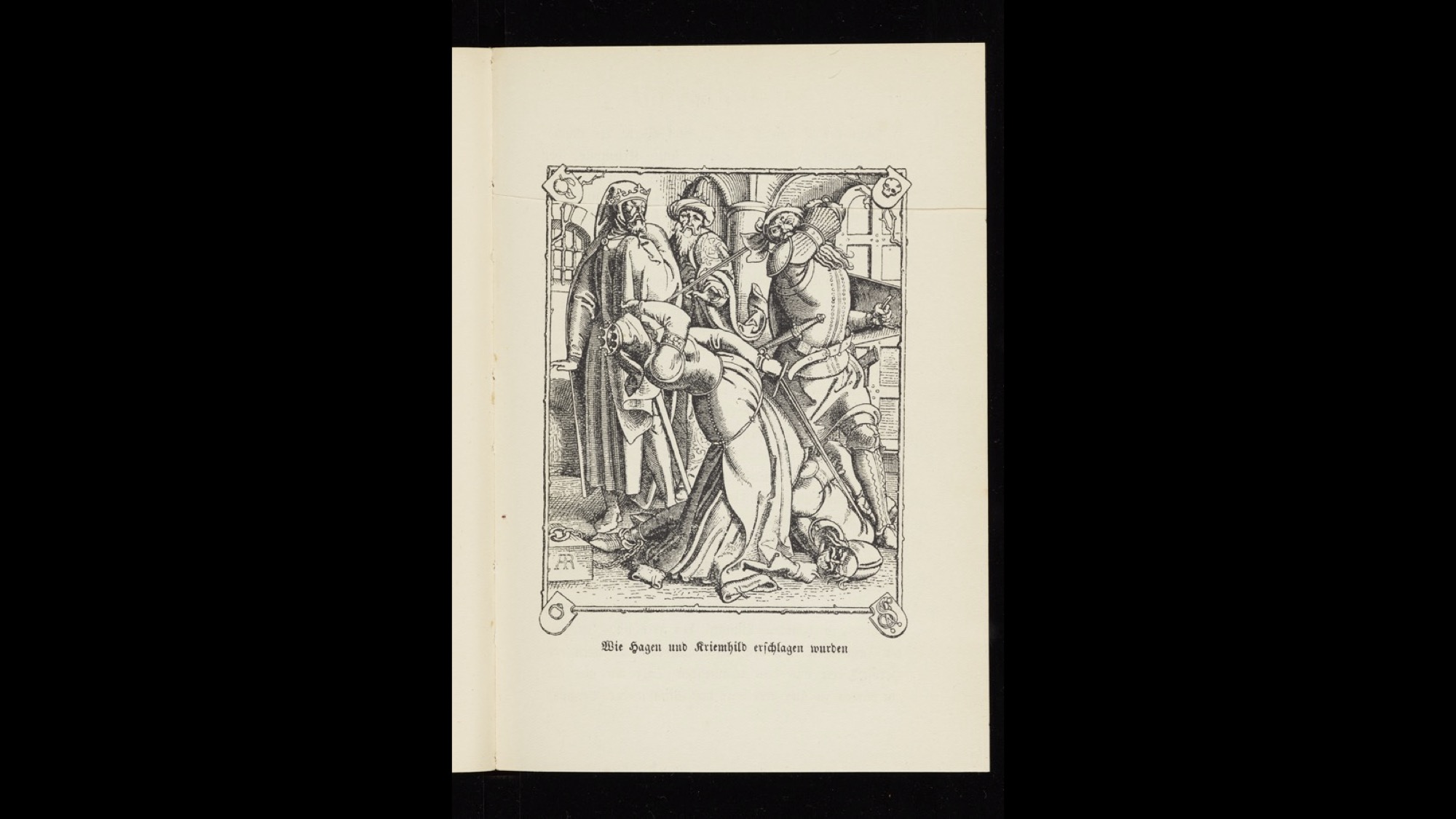
Exhibit 2:
Wie Hagen und Kriemhild erschlagen wurden' [How Hagen and Kriemhild were slain]
G. Hugelshofer and A.F.C Vilmar, Analysis of the Nibelungenlied as contained in the Geschichte der Deutschen [sic] National-Litteratur, London, 1913. Woodcut by Xylographische Anstalt von Kaspar Braun & [Georg] von Dessauer, based on an illustration by Alfred Rethel.
The Bodleian Libraries, University of Oxford: 28849 f.6
'How can the greatest knight be lying dead at a woman's hands? … She shall not benefit from daring to slay him.'
Nibelungenlied, stanzas 2374-75
This depiction of active violence against a woman is deliberately shocking: Kriemhild's wickedness, evidenced by the body of her final victim at her feet, allows her brutal death to be illustrated. Both these books, for younger audiences, incorporate reproductions of older images, originally directed at adults.
Brünhild hurls her spear
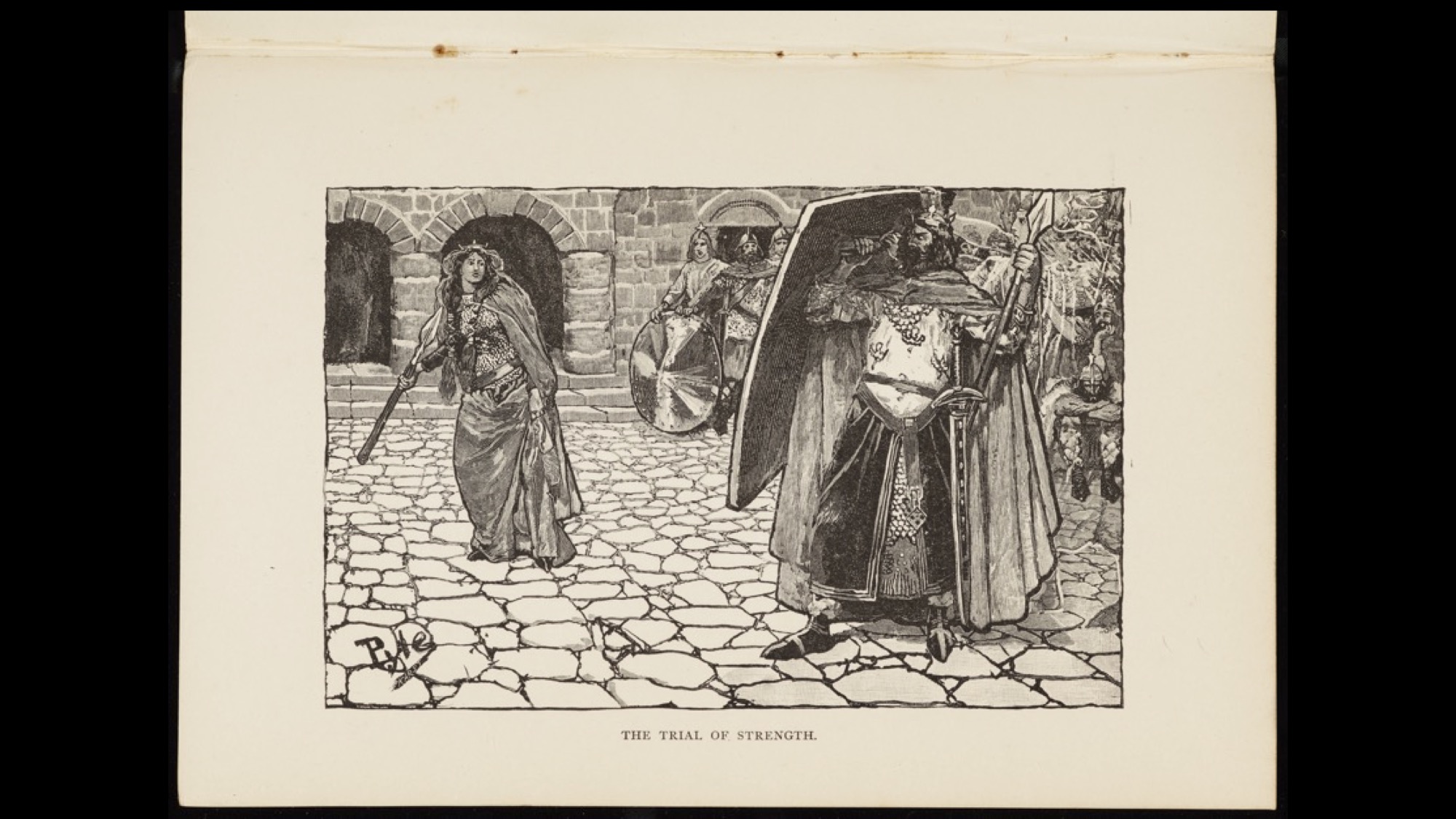
Exhibit 1:
'The Trial of Strength'
James Baldwin, illustrated by Howard Pyle, The Story of Siegfried, (London, 1883).
The Bodleian Libraries, University of Oxford: (OC) 251 k.796
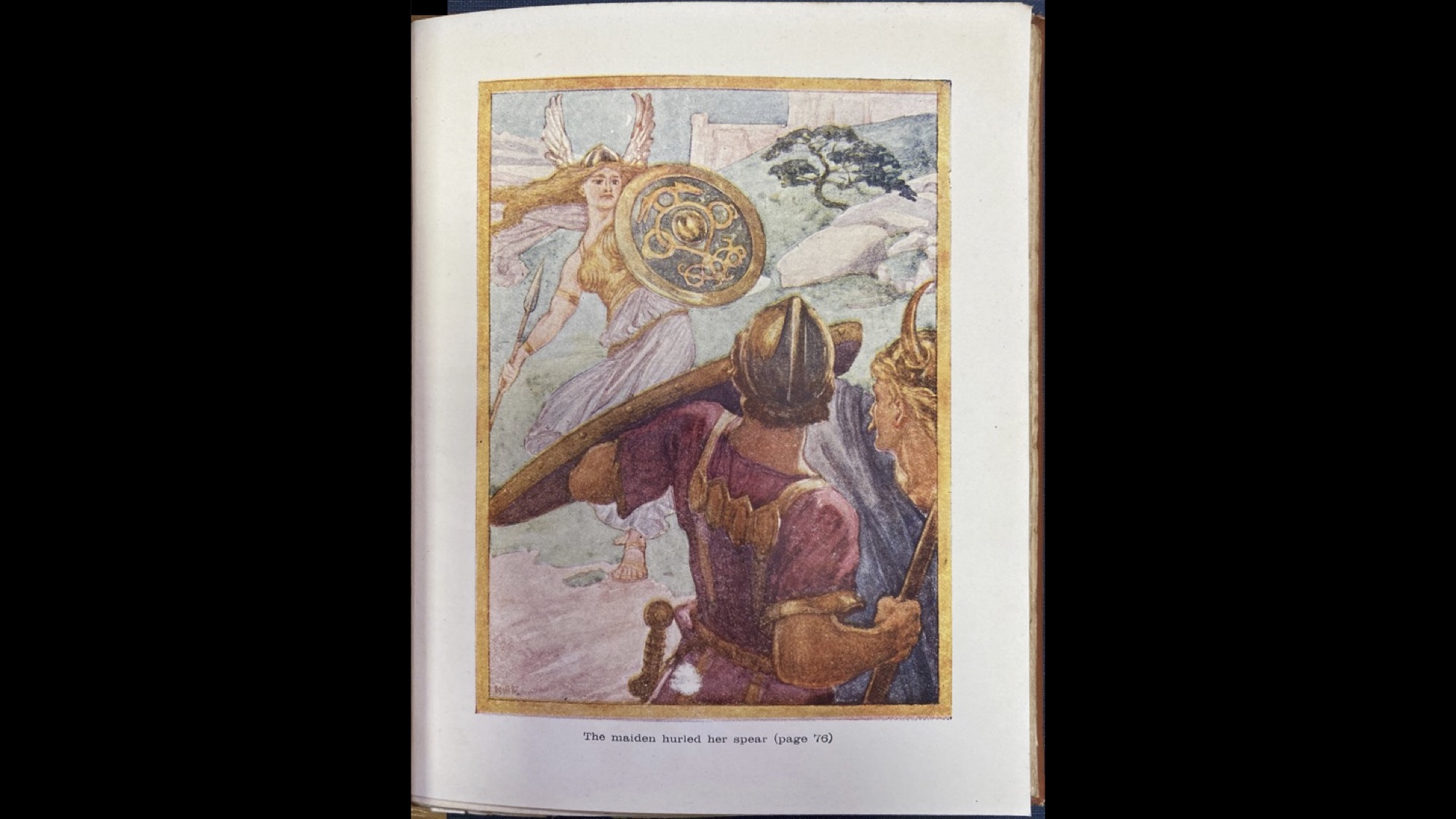
Exhibit 2:
'The maiden hurled her spear'
Mary MacGregor, Stories of Siegfried, told to the children, with pictures by Granville Fell, London, c. 1908.
Private loan
'The remarkable maiden threw the spear with great force'
Nibelungenlied, stanza 456
Children's adaptations often include images of the supernaturally strong warrior queen, Brünhild. Here, in a trial of strength for her hand in marriage, she prepares to hurl a spear at a shield, behind which are sheltering Gunther and - unbeknownst to Brünhild - an invisible Siegfried, who will win the trial on Gunther's behalf.